


In the world of video game development, the pursuit of realism can sometimes lead to unexpected and darkly comedic consequences. The team behind The Witcher 3: Wild Hunt discovered this firsthand when their dedication to creating an immersive, living world resulted in one of the most bizarre bugs in gaming history: female NPCs who would unceremoniously drop their babies on the ground whenever danger approached. This amusing development anecdote offers a fascinating glimpse into the complex challenges of creating believable virtual worlds and the unintended consequences that can arise from even the most well-intentioned design decisions.
In a recent interview with Edge Magazine, CD Projekt Red quest designer Philipp Weber revealed the details behind this peculiar glitch and the philosophy that led to its creation. The development team was laser-focused on making the rural villages scattered across The Continent feel genuinely alive and inhabited by real people with authentic daily routines. This attention to detail was particularly important for smaller settlements where players would naturally be more observant and curious about whether the world felt genuine or artificial.
The Philosophy Behind Living, Breathing NPCs
Weber explained that the team’s approach stemmed from their understanding of player psychology and the unique challenges of creating believable small communities. “If a village only has eight houses, people will want to see if the people truly exist in the world, or if it’s just fakery,” Weber noted during the interview. “Lots of people nowadays are interested in those kinds of details, and it really came to haunt us.” This philosophy of rewarding curious players who explore every corner of the game world has become a hallmark of CD Projekt Red’s design approach, helping establish The Witcher 3 as one of the most celebrated open-world games ever created when it launched in 2015.
The development team invested significant resources into creating authentic day and night cycles for NPCs, giving them schedules and behaviors that would make each character feel like a genuine inhabitant of their village rather than a static decoration. However, this focus on simulation came at a cost. Weber admitted that while the team excelled at creating routine behaviors, they hadn’t devoted as much attention to how NPCs would react to the player character, Geralt of Rivia, and his often chaotic presence in their world.
When Realism Goes Wrong: The Baby-Dropping Bug
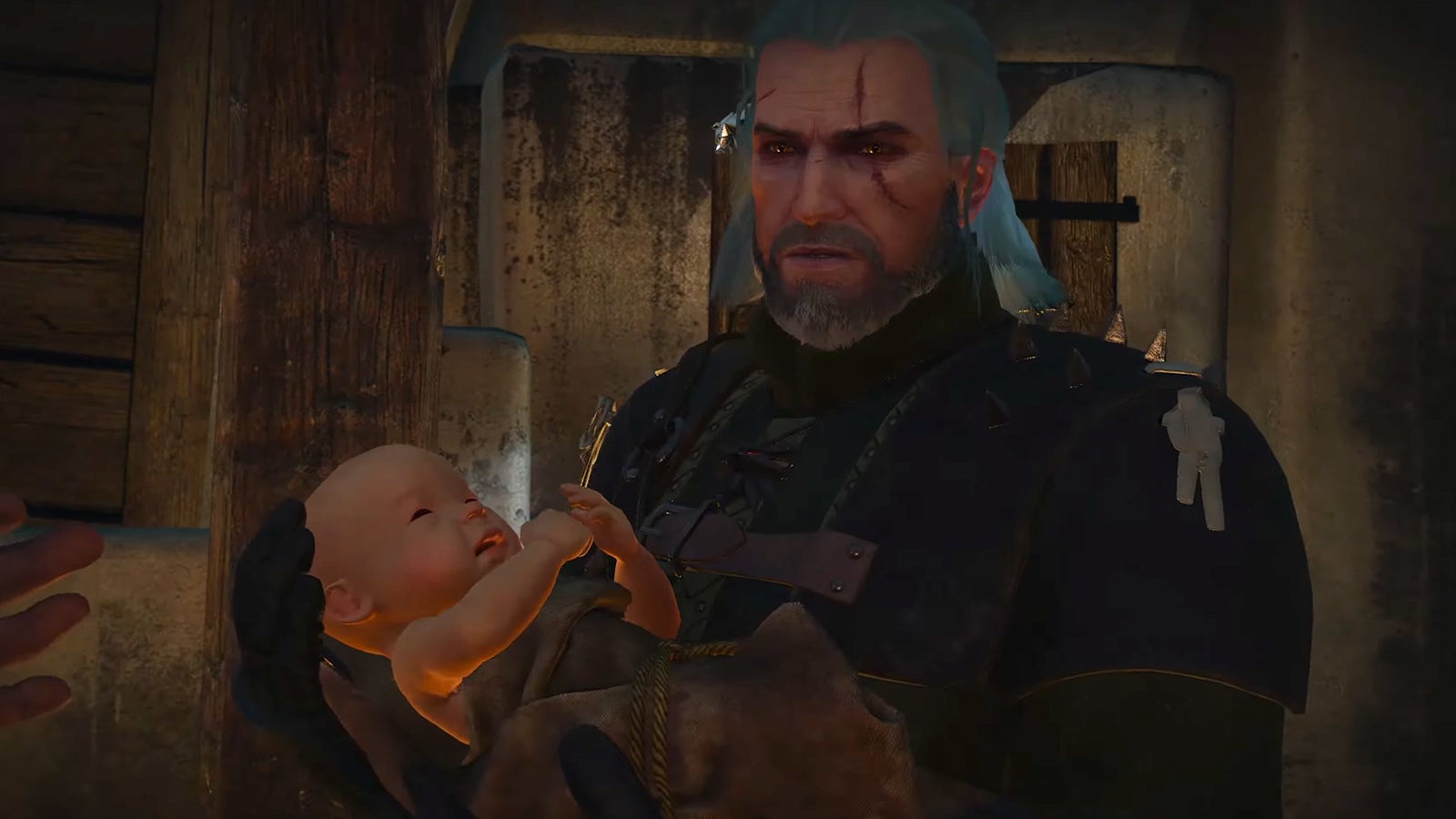
The consequences of this oversight became apparent in spectacular fashion. The NPCs were programmed to drop whatever they were holding and flee when confronted with danger, which seemed like a perfectly reasonable response to a sword-wielding witcher bursting into their homes. Unfortunately, the game’s logic didn’t distinguish between the various objects NPCs might be carrying. “They would drop what they’re currently working on, that thing would fall to the ground, and they’d run away, afraid,” Weber explained. This meant that female characters who were holding babies would simply release them and run, leaving infants scattered on the ground throughout The Continent’s villages.
“For a few weeks, women were just dropping their babies, left and right,” Weber revealed with what one can only imagine was a mixture of horror and amusement. The bug persisted through multiple development builds before being identified and resolved, creating what must have been some truly surreal testing sessions for the quality assurance team. While the issue was ultimately fixed before the game shipped to millions of players worldwide, it stands as a perfect example of how complex systems in game development can interact in completely unexpected ways.
The Technical Innovation Behind NPC Behavior
Beyond the amusing anecdote, Weber’s interview shed light on the sophisticated systems CD Projekt Red developed to bring The Witcher 3’s world to life. Rather than scripting specific paths and behaviors for each individual NPC, the developers created a more dynamic system based on points of interest. “Most NPCs in villages, we don’t give them specific paths,” Weber explained. “We give them spots of interest that are available and then they’re the ones doing the pathfinding.” This approach meant that characters would autonomously choose their next activity based on available options, creating more organic and varied behavior patterns.
This system proved particularly effective for managing larger crowds and complex areas. Weber cited the Novigrad harbor as an example, where approximately fifty sailors needed to appear busy and purposeful without following obviously repetitive patterns. “For the 50 sailors at Novigrad harbour, for example, we made 200 possible spots, so even if all 50 were active at the same time, they would have options,” he explained. This ratio of four potential activities per NPC ensured that the harbor always felt dynamic and alive, with sailors engaged in different tasks at any given moment. This technique has since influenced numerous other open-world games seeking to create similarly immersive environments.
Looking Forward: The Future of The Witcher Series
The lessons learned from The Witcher 3’s development continue to inform CD Projekt Red’s work on future projects. The studio is currently developing the next entry in The Witcher series, which will center on Ciri, the ashen-haired warrior who served as a central character in Wild Hunt. While the game doesn’t yet have an official release date, eager fans received their first glimpse of early gameplay footage during the State of Unreal 2025 showcase, generating significant excitement within the gaming community. Given the studio’s decade of additional experience since The Witcher 3’s release, fans can likely expect even more sophisticated NPC behavior systems, hopefully without any accidental baby-dropping incidents.
The anecdote serves as a reminder of the incredible complexity involved in creating modern video games, where thousands of interconnected systems must work together seamlessly to create cohesive experiences. CD Projekt Red’s commitment to authenticity and immersion helped make The Witcher 3 a landmark achievement in gaming, even if that dedication occasionally resulted in some darkly humorous bugs along the way. As developers continue pushing the boundaries of what’s possible in interactive entertainment, we can expect more stories like this to emerge, reminding us that behind every polished final product lies countless hours of debugging, testing, and fixing the kind of unexpected problems that arise when virtual worlds become complex enough to surprise even their creators.
Expert Opinion: This development anecdote highlights a fundamental challenge in modern game design: emergent behavior systems can create unexpected interactions that even experienced developers fail to anticipate. As games increasingly rely on AI-driven NPCs and dynamic systems rather than scripted sequences, studios will need to invest more resources in edge-case testing and behavior validation. The upcoming Witcher title will likely feature significantly more sophisticated safeguards against such logical errors, reflecting a decade of industry-wide learning about managing complex interactive systems.